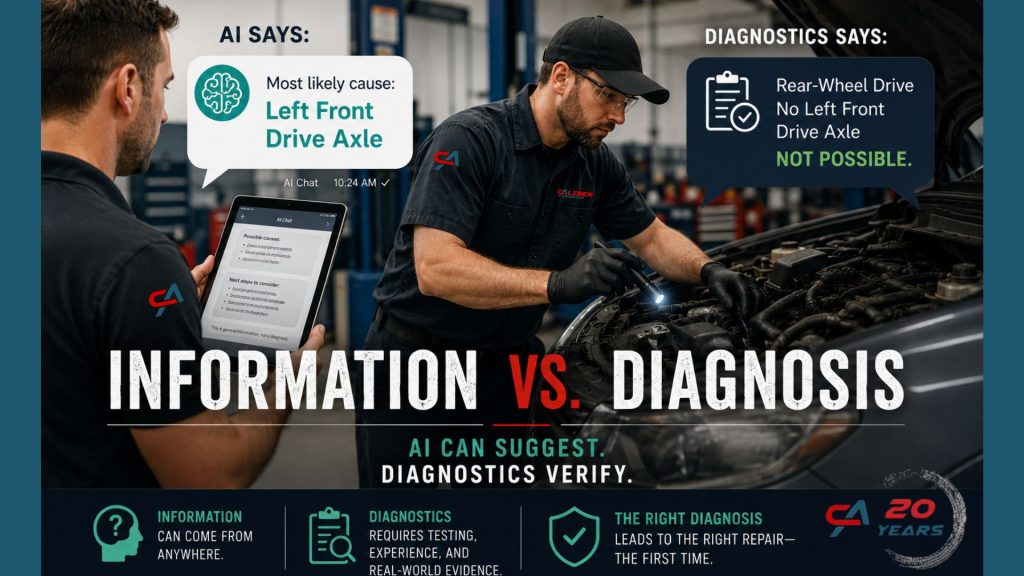
“AI” Said It Needed a Drive Axle. The Vehicle Didn’t Even Have One.
Why Professional Diagnostics Are Still Important in the Age of Artificial Intelligence
Not long ago, a customer called our shop to schedule a left front drive axle replacement.
When our service advisor asked how they came to that conclusion, the customer answered, “AI says it’s the axle.” The customer explained the symptoms, received what seemed like a confident answer, and was ready to move ahead with the repair.
When the vehicle showed up, our technician was immediately confused. The vehicle was a rear-wheel-drive model. There was no left front drive axle—not a worn one, not a damaged one, and certainly not a failed one. There simply wasn’t one on the vehicle. The repair the customer requested wasn’t just incorrect—it wasn’t possible.
Ten years ago, we regularly heard, “Google says it’s my oxygen sensor.” Or, “The internet says I need a fuel pump.” Then it was, “I found it on a forum, a guy talking about the exact same thing”.
The technology has changed. And, today, those conversations begin with, “AI says it’s this.”
The problem isn’t artificial intelligence. The real problem is assuming information is the same thing as a diagnosis. When it comes to repairing modern vehicles, those are two very different things.
The Danger of Starting With the Answer
One of the most common mistakes in vehicle repair is deciding what needs to be replaced before determining what is actually wrong.
That doesn’t just happen with AI. It happens with internet searches, online forums, and advice from friends and family. This will even happen inside repair facilities when proper diagnostic procedures aren’t followed. A diagnosis is the outcome after testing, analysis, and verification. A symptom, a guess, or a “likely” cause is not a diagnosis.
Without the steps of gathering information and testing, decisions are based on assumptions rather than evidence. Sometimes you’ll get lucky. Most times you won’t. AI can’t.
Your Vehicle Is More Like a Patient Than an Appliance
One of the easiest ways to understand diagnostics is to compare it to medicine.
Imagine telling a doctor, “I have a headache.”
A headache could be caused by stress, dehydration, lack of sleep, eye strain, illness, or dozens of other factors. A good doctor doesn’t jump straight to treatment based on a single symptom. They ask questions, gather information, perform tests when necessary, and verify the cause of the problem before recommending treatment.
Vehicle diagnostics work much the same way.
Many different faults can create identical symptoms. A rough-running engine, for example, might be caused by:
- An ignition issue
- A vacuum leak
- A fuel delivery problem
- A sensor fault
- A mechanical concern
- A software-related issue
The symptoms are usually obvious. The cause often is not.
That’s why professional diagnostics exist.
Why Good Technicians Sometimes Disagree with Google, Forums, and AI
One of the most important responsibilities of a professional technician is to follow evidence rather than make assumptions. Clients often arrive with a theory about what’s wrong with their vehicle. Sometimes they’re correct, sometimes they’re not. An important distinction in what we do is that we take the theory and challenge it, not to disprove it but to see whether it is supported by evidence.
A technician who immediately replaces the part someone suspects has failed may occasionally solve the problem (we call this the silver bullet). A technician who tests and verifies before recommending repairs will consistently solve the problem.
There are plenty of avenues for information. I have gone down the rabbit hole of plenty of them, and to be honest, there are more often than not misrepresented threads of information; all in good intention, but if you don’t know how to differentiate between right information and wrong information, you will end up frustrated and confused, back at square one–or worse.
What We Mean When We Talk About Diagnostics
The word diagnostics is used frequently in the automotive industry, but it’s often misunderstood.
Simply put, diagnostics is the process of gathering evidence before recommending repairs; it is more of an analysis.
As technicians, we ask questions to get detailed information about the symptoms, determine a test plan, inspect components and perform isolated system tests, and verify our findings to prove the fault so we can provide a diagnosis, identifying the root cause before any parts are recommended, let alone replaced.
Modern vehicle testing involves analyzing onboard systems, evaluating operating data, considering driver observations, and understanding how multiple systems interact. This process protects vehicle owners from unnecessary repairs and ensures the actual problem is addressed.
Proper testing and analysis take time, period, and always cost less than replacing parts that never needed replacing.
If AI Could Respond — So I Asked It To
The following response was generated by ChatGPT when asked about its role in vehicle diagnosis:
If you tell me your vehicle is making a noise, vibrating, running rough, or displaying a warning light, I can absolutely help explain what might be happening.
I can explain how systems work.
I can tell you what commonly causes certain symptoms.
I can help you understand terminology, repair recommendations, and warning lights that might otherwise seem confusing.
I can’t inspect your vehicle.
I can’t hear the noise you’re hearing.
I can’t feel the vibration you’re feeling.
I can’t verify a test result.
I can’t inspect a component.
And despite what some people might think, I definitely can’t crawl underneath your vehicle with a flashlight and a wrench.
I can only work with the information I’m given.
That means every answer I provide is based on probabilities, patterns, and possibilities—not direct observation, testing, or verification.
Sometimes I’ll identify the most likely cause.
Sometimes I’ll give you several possibilities.
What I can’t do is tell you with certainty which one is correct without evidence.
That’s where professional diagnostics come in.
A qualified technician has access to something I never will:
The vehicle itself.
They can inspect it.
They can test it.
They can verify what’s actually happening rather than what merely seems likely.
So by all means, use me to learn.
Use me to ask better questions.
Use me to better understand your vehicle.
Just don’t confuse a conversation with a diagnosis.
When it comes to vehicle repairs, evidence matters.
And if there’s one thing I’d want every vehicle owner to remember, it’s this:
Information can point you in a direction. Only testing can tell you whether you’re headed the right way.
The Difference Between Information and Evidence
Artificial intelligence can be an excellent educational tool. It can help vehicle owners understand how their vehicles work, explain warning lights, clarify repair recommendations, and make technical terminology easier to understand. It can help you ask better questions. It cannot replace testing.
At Caliber Automotive, we always encourage vehicle owners to be informed. We encourage questions. We encourage curiosity. An informed vehicle owner is a better vehicle owner.
But there is a line between education and hands-on experience in the bay: testing and analyzing. Education helps you understand possibilities, while testing identifies reality.
That’s why we won’t replace parts based on assumptions. We won’t replace parts because an internet search suggested it. And we won’t replace parts because an AI assistant identified the most likely cause. We gather evidence, test, verify. Then we make accurate recommendations.
Your vehicle deserves evidence before repairs are recommended.
And honestly, so do you.