
Edmonton Flash Flooding: When Splashing Through Water Leads to Costly Repairs
If you’re like me, you still get a kick out of driving through a big puddle.
The bigger the splash, the more fun it feels.
You know the feeling. You see some standing water, no cars are nearby, and for a moment you think,
“This is going to be good.”
Sometimes it is.
Until it isn’t.
With the recent flash floods in Edmonton, many drivers have come across standing water on roads that usually drain just fine. Most cars make it through without any obvious problems, but some end up with immediate consequences and sometimes damage you might not notice right away.
The tricky part is knowing if there is any damage.
Why Floodwater Can Damage an Engine
Your engine is designed to compress a mix of air and fuel thousands of times every minute.
Air compresses.
Water does not.
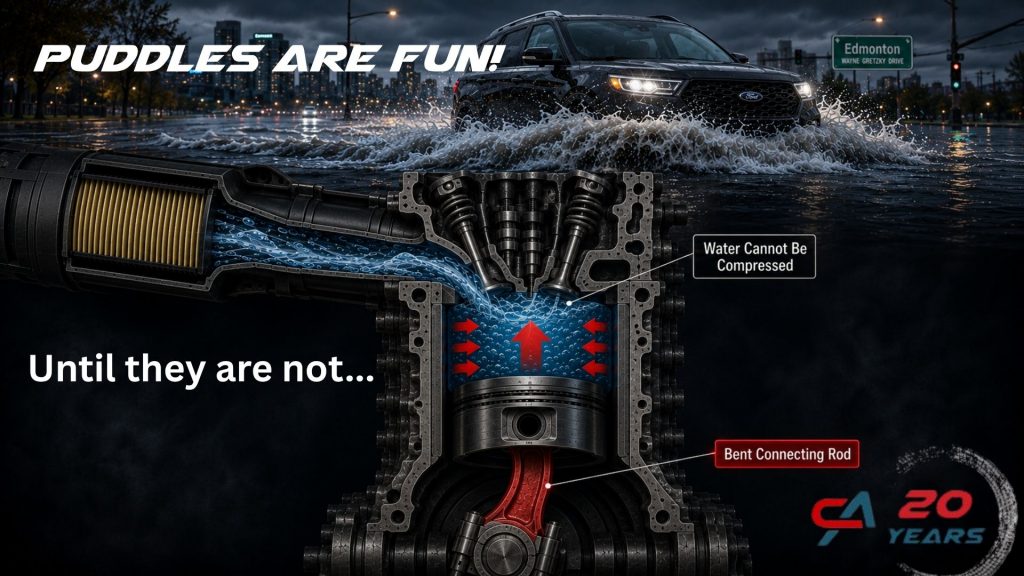
If the engine’s air intake pulls in enough water, it moves through the intake system and into the combustion chamber.
When the piston moves up, it tries to compress the water.
Since water can’t really be compressed, the pressure shoots up right away.
All that force has to go somewhere.
Often, it bends the connecting rod, but almost always it stops the engine cold in its rotation.
This is called hydrolocked. Depending on how much water gets in and how fast the engine is running, it can cause anything from a bent connecting rod to cracked pistons, damaged crankshafts, broken engine blocks, leaving you needing a whole new engine, at the very least water will make its way into the crankcase and contaminate the engine oil.
Why Speed Makes Everything Worse
Here’s the surprising part.
We all know, the faster you drive through standing water, the bigger the splash.
But that’s exactly what makes things riskier.
A big wave of water gets pushed up into the engine area, making it much easier for the air intake to suck in water.
Driving fast also means you hit anything hidden under the water with more force.
That can include:
- Damaged splash shields
- Broken underbody panels
- Cracked bumper components
- Bent protective covers
- Hidden potholes
- Curbs
- Debris washed onto the road.
What seemed like harmless fun can quickly turn into a costly repair. Just the other day I saw a hood, a bumper and countless splash shields on the roadway after a storm, of course all of these parts were located right where there was a flood during the storm.
Damage Doesn’t Always Show Up Right Away
A common myth is that if your car is still running, everything must be fine.
But that’s not always the case.
A bent connecting rod might let the engine keep running, even though there’s already damage inside.
Water will also affect:
- Engine air filters
- Intake ducting
- Electrical connectors
- Engine oil
- Transmission and driveline fluid
- Wheel bearings
- Brakes
- Suspension components
Some problems show up right away.
Others might not show up until days or even weeks later.
Warning Signs After Driving Through Deep Water
If your vehicle recently traveled through floodwater, watch for:
- Rough running
- Reduced power
- Check Engine Light
- Unusual engine noises
- Hard starting
- Vibrations
- Fluid contamination
- Loose or dragging splash shields
If your engine stalls while driving through water, don’t keep trying to restart it. This can make the internal damage worse.
The good news is that most cars that go through standing water don’t end up with major damage.
The key is knowing if your car is one of the lucky ones.
A post-flood inspection lets us check the intake system, look for water getting in, check underbody protection, and spot any damage that might not be easy to see right away.
Sometimes, the best thing you can hear is,
“Everything looks great.”
And that’s always good to know.
Splashing through water should end with a laugh, not a huge repair bill.
Have Questions?
If your car recently went through deep water in Edmonton and you’re not sure if it was affected, we’re happy to take a look and explain what we find. Whether everything is fine or something needs fixing, you’ll leave knowing exactly what shape your car is in.